

Your client asks for one more thing. You say yes.
Your retainer has just changed.
The fee has not. The contract has not. But your client’s understanding of what they bought has.
Do that often enough, and you end up delivering an engagement you never priced.
The difficult part? You helped build it.
You wanted to demonstrate value. Build trust. Make the client glad they hired you. Now you worry that setting a limit will put the relationship at risk.
What began as a generous exception has become an expectation you are afraid to challenge.

What you intended. What the buyer learned.
You joined the daily stand-up because the team was struggling that week.
The client learned that you attend the daily stand-up.
You took over reporting while they hired an analyst.
The client learned that you own reporting.
You answered a Saturday message because you happened to be available.
The client learned that Saturday is a reasonable time to expect a response.
Experienced leaders step in when the business needs them. The problem is leaving the exception unexplained.
From your perspective, you are going beyond the agreement. From the buyer’s perspective, they are discovering what the agreement includes.
You are keeping score of your generosity. They are learning how to work with you.
That is why “set better boundaries” is incomplete advice. You need an agreement that makes the commitment clear before work begins, and a process for revisiting it when business needs change.
The first boundary is set before the first invoice
It is easier to agree on expectations before the engagement than to change them after the client has become accustomed to your availability.
That is why your proposal needs to make two things explicit: what you are responsible for achieving and what you do not do.
Your expertise may span the entire function. Your retainer covers a defined commitment within it.
The buyer also needs to understand when you can be reached, what support their team must provide, and how additional responsibilities will be agreed.
These expectations belong in the proposal conversation, while both of you are deciding whether the arrangement works.
You may worry that naming exclusions will make your offer less attractive. But clarity gives the buyer something valuable: confidence about what they can depend on.
You are demonstrating that you know what it takes to deliver the outcomes they are paying for.
Once the engagement starts, your behaviour needs to reinforce that agreement. When you make an exception, explain what you are accommodating and for how long.
Otherwise, the proposal says one thing while your actions teach the client something else.
But what if the engagement is already underway and those expectations were never set? Start by identifying where the work has expanded so you can bring the client a clear recommendation for resetting it.
Audit what your retainer has become
Imagine a $10,000 monthly retainer structured around one day a week.
It now takes two.
The fee has stayed the same. The capacity required has doubled.
You are bringing the same expertise, judgment, and accountability. You are providing substantially more of it without revisiting the commercial arrangement.
That additional day could support another client, build your pipeline, or give you the freedom you started this business to create.
Before you raise the issue, identify exactly what changed.
Choose one retainer. Pull up the proposal, your calendar, and the last four weeks of requests.
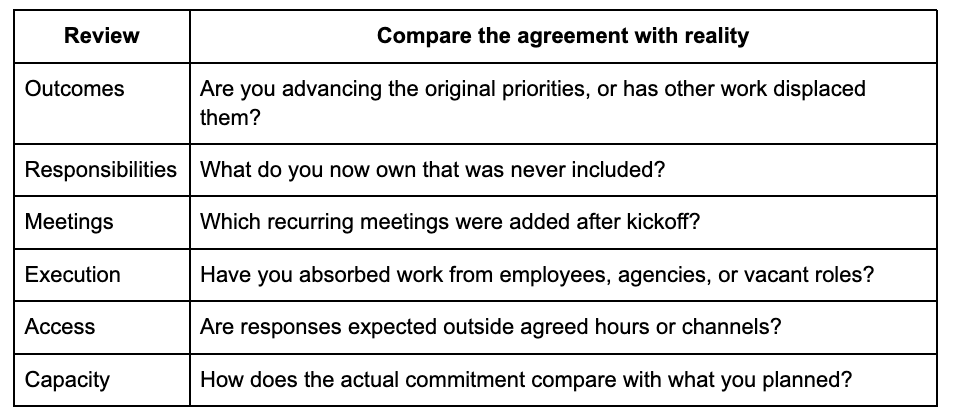
Include preparation, follow-up, and coordination. A meeting can create considerably more work than the time on the invitation.
Mark each addition as agreed, temporary, or never discussed.
Then use these five questions to decide what needs to change.
1. Are we still working toward the outcomes we agreed?
You can stay busy while the reason you were hired slips further down the list.
Perhaps you were brought in to improve forecast reliability. Now your week is consumed by presentations, internal meetings, and last-minute requests.
Ask:
“Our agreed priority was [outcome]. These additional requests are taking capacity away from it. Has the business priority changed, or do we need to redirect our attention?”
If the priority has changed, update the plan together. Identify what stops, what moves, and how success will now be measured.
2. Am I leading the function or absorbing its execution gaps?
Owning an outcome does not automatically mean performing every task required to achieve it.
Look at the work you absorbed. Does it require your expertise? Was it included in the engagement? Who was supposed to execute it?
Then recommend an arrangement:
“I’ll continue to own campaign strategy and performance. Campaign production needs a dedicated execution owner. We can assign that internally or bring in support. If you want my business to provide that execution, I’ll scope it separately.”
Also check whether you have the authority and resources needed to deliver. Responsibility for an outcome needs to be matched by the ability to influence it.
3. Does the client know when and how they can reach me?
“I have other clients” does not tell this client when to expect a response.
If availability was never clearly defined, establish the days, hours, time zone, channels, and response window now.
“I want to make our communication expectations explicit. My routine response window will be [arrangement]. Requests received outside those hours will be picked up during the next window. Completion timing will depend on the work required and our agreed priorities.”
Discuss any genuine need for urgent coverage. If the business requires a greater level of access, that requirement belongs in the scope and fee.
4. What decision happens when new work arrives?
If the answer is “I find a way,” every addition becomes your problem to absorb.
Give new work three possible routes:
Swap: Replace an existing priority.
Schedule: Put it into a later agreed period.
Expand: Add scope, capacity, and fees.
Use this language:
“I can help with that. It adds to our current commitment. We can move another priority, schedule it for the next cycle, or expand the engagement. My recommendation is [option] because [business reason].”
You are giving the buyer a clear way to get what they need, with the trade-offs visible.
5. Which temporary exceptions need an end date?
A temporary responsibility needs an owner, an end date, and a handover plan.
“I can cover reporting through November 15. Before then, we’ll identify the ongoing owner and arrange the handover. If you need me to continue, we’ll agree on the additional commitment before that date.”
Record the decision and revisit it before the deadline. Otherwise, temporary support can become a permanent expectation.
Turn the audit into a conversation
You do not need to present a catalogue of every favour you have done.
Bring the original priorities, the material additions, and a recommendation.
“When we started, we agreed that I would own [priorities]. Since then, I’ve also taken on [specific additions].
“That is reducing the capacity available for [agreed outcome]. I recommend we [specific change].
“If you want me to retain the expanded responsibilities, I can propose the scope, capacity, and fee for that arrangement.
“I’ve accommodated the additions without making the trade-offs clear. Let’s agree on how we will work going forward.”
Confirm the decisions, owners, and effective date in writing.
This week, audit one retainer, identify the biggest gap, and book that conversation.
If you are preparing your first retainer, put the expectations in your proposal before the buyer signs.
The goal is a retainer you would willingly sell again at the same fee and commitment.
If you would hesitate to offer today’s arrangement to a new client, your existing one needs a conversation.
Your fractional business should have room to grow.
If your retainers keep expanding while your revenue stays flat, let’s look at how your engagements are structured.
Book a roadmap call to discuss where your business is getting stuck and whether FractionalOS™ is the right fit to help you build it differently.
Fractional powerhouses are not born. They are built.
— Sue

Connect on LinkedIn | The Fractional Formula (Book) | FractionalOS™ |
Sue, an important distinction between what a fractional leader agrees to deliver and what the client gradually learns to expect.
I'd extend this beyond scope and retainer economics.
The greater risk may be that the client gets more of the fractional leader's time but less of the judgment they originally hired them for.
Stepping into execution isn't necessarily the problem. Sometimes that's precisely what the business needs to overcome a constraint.
The problem begins when execution becomes the default, rather than a deliberate intervention serving the outcomes the engagement was meant to achieve.
Both parties may feel productive while the underlying growth constraints remain unresolved.
So I'd add a sixth question to your five:
Is the engagement helping the business make better decisions and build the capability to deliver outcomes, or making it increasingly dependent on the fractional leader to keep things moving?
Sometimes the answer is to reset scope and fees. Sometimes it's to rethink priorities, decision rights, execution ownership, or even the original mandate.
The distinction matters as much to the CEO as it does to the fractional leader.