

Your buyer does not wake up wanting a fractional executive.
They wake up with a problem.
Revenue has stalled. Margins are slipping. A product is late. The leadership team is misaligned. Growth has exposed operational gaps that nobody has time to fix.
They may not know fractional leadership exists.
They only know something important is not working.
Then they encounter you.
Perhaps they see a post, receive an introduction, land on your website or open an email.
If they cannot immediately recognize that you understand their problem, they leave.
That is a positioning failure.
If they recognize the problem but cannot work out what you would actually do about it, they leave.
That is a packaging failure.
If your message and offer are clear but the right buyers rarely encounter them, there is nothing to respond to.
That is a promotion failure.
And if they begin a conversation but there is no clear path from interest to decision, the opportunity drifts until it disappears.
That is a pipeline failure.
You experience all four as the same thing:
No client.
The buyer experienced four completely different reasons to stop moving.

The expensive response to every pipeline problem
When conversations dry up, most people do more.
More posting. More networking. More outreach. More events. More messages to former colleagues asking if they know anyone who might need help.
Activity feels like the obvious answer because activity is visible.
But adding activity before identifying where the buyer stopped is like turning up the water pressure when the pipe is leaking.
You do not fix the system.
You simply push more people toward the same break.
There is an order to building a fractional pipeline because there is an order to how buyers make decisions:
Is this relevant to me?
What exactly would I be buying?
Have I seen enough to trust this?
What happens next?
Your business must answer those questions in the same order.
One. Positioning
The buyer’s first question is not, “How experienced is this person?”
It is, “Is this relevant to what is happening inside my business?”
Your positioning must connect four things:
A recognizable buyer
A costly problem
A meaningful business outcome
A reason the problem matters now
Your title does not do that.
“Fractional COO with twenty-five years of cross-functional leadership experience” may be accurate, but it forces the buyer to translate your background into their problem.
Most buyers will not do that work for you.
Strong positioning sounds closer to:
I help founder-led software companies restore predictable delivery when rapid growth has outpaced their operating systems.
The buyer can recognize the company, the problem and the desired result.
That does not mean this is the only work you can do.
It means this is the door through which the right buyer enters.
The positioning test
Put your current positioning in front of five people who understand your intended market.
Do not ask, “Do you like this?”
Ask:
Who do you think this is for?
What problem do you think I solve?
When would someone need this?
What would they expect to change after hiring me?
If their answers are vague or inconsistent, your positioning is not clear enough yet.
Do not fix it by adding more words.
Make the buyer, problem and outcome more specific.
Two. Packaging
Once the buyer recognizes themselves, their next question is:
“What exactly would I be buying?”
This is where experienced executives often mistake flexibility for value.
“I provide advisory support.”
“Every engagement is customized.”
“Let’s talk about what you need.”
Those statements may feel buyer-friendly, but they transfer the work of defining the engagement back to the buyer.
The buyer now has to determine what you will do, how long it will take, what success looks like and how much support they require.
That is too much uncertainty.
Packaging turns expertise into a decision.
A buyer should be able to understand:
The problem the engagement addresses
The outcome it is designed to create
What happens during the engagement
How long it takes
What they will need to contribute
What the next step is
The delivery can still be tailored.
The buying decision cannot be completely bespoke.
The packaging test
Take your primary offer and give it to someone who was not involved in creating it.
Give them sixty seconds to review it.
Then ask:
What would you be hiring me to accomplish?
What happens first?
What would you expect to have by the end?
How would you know whether it worked?
If they describe your activities but cannot name the outcome, the offer is still packaged around your work rather than the buyer’s result.
If they cannot explain what happens next, the buying path is still too vague.
Why referrals can hide both problems
Your first clients often come from people who already know you.
They know what you accomplished inside corporate. They understand what you are capable of. They can translate a broad description of your work because they already have the missing context.
A referred buyer also receives borrowed trust from the person making the introduction.
This allows unclear positioning and loosely defined offers to work for a while.
Then the warm network begins to run out.
Strangers do not fill in the blanks the way former colleagues do. They do not know which parts of your career matter. They do not automatically understand how your experience connects to their business.
What looks like a sudden pipeline problem is often an old positioning or packaging problem that referrals were temporarily covering.
Three. Promotion
Only after the message and offer are clear should you add volume.
Promotion is not simply posting.
It is repeatedly putting a relevant problem, useful point of view and clear next step in front of a defined group of buyers.
That can happen through content, direct outreach, partnerships, events, introductions, communities or a combination of channels.
But the buyer, problem and offer must remain consistent long enough for the market to recognize you.
Many fractionals change all four at once.
They speak to one market on LinkedIn, contact another through email, attend events filled with a third, and promote three different services depending on the week.
They are active everywhere and recognizable nowhere.
The thirty-day promotion test
For the next thirty days, choose:
One primary buyer
One urgent problem
One offer
One primary conversation channel
One clear next step
Each week:
Start ten new conversations with right-fit people
Complete every follow-up that is due
Publish or share one useful idea that demonstrates how you think
Invite interested buyers to one specific next step
Track:
Responses from right-fit buyers
Two-way conversations
Qualified sales calls
Do not use impressions, likes or follower growth to judge whether your pipeline is working.
Those numbers may tell you whether content travelled.
They do not tell you whether buyers moved.
Four. Pipeline
Pipeline comes last because it can only manage demand that already exists.
It cannot rescue unclear positioning.
It cannot make a vague offer easier to buy.
It cannot create conversations with buyers who have never encountered you.
A useful pipeline tells you where each buyer is in the decision process and what must happen next.
At minimum, track:
Right-fit buyer identified
Two-way conversation started
Discovery or diagnostic conversation held
Qualified opportunity confirmed
Proposal or decision process underway
Won, lost or deferred
Every active opportunity must have:
A clear business problem
A buyer with authority or access to authority
A reason to act
A defined next action
A date for that action
“I will check back in a few weeks” is not a next step.
“Send the operating diagnostic by Thursday and review it with the COO on Tuesday” is.
Your pipeline should show you where the buyer stopped moving.
If it is only a list of names, it is a contact database.
The thirty-minute Pipeline Sequence Audit
Take your last five relevant buyer conversations.
For each one, write down the furthest point the buyer reached.
Then diagnose the first break
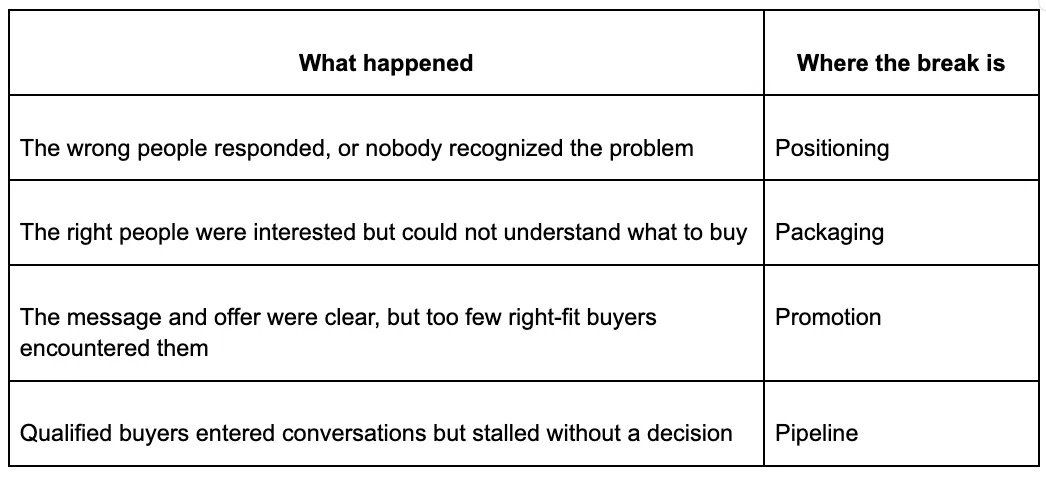
Fix the earliest broken layer first.
If positioning is unclear, do not increase promotion yet.
If positioning works but the offer is vague, fix packaging before creating more leads.
If both are clear but conversations are scarce, promotion is the constraint.
If qualified conversations are happening but not progressing, inspect the pipeline, discovery process and next steps.
The first break wins.
That is where your next thirty days should go.
Do not confuse sequence with perfection
You do not need a flawless positioning statement before testing an offer.
You do not need a perfect offer before speaking to buyers.
You do not need a sophisticated CRM before starting sales conversations.
You need a minimum viable version of each layer:
One positioning statement a buyer can accurately repeat
One offer a buyer can understand
One promotion rhythm you can maintain
One pipeline process that gives every opportunity a next step
Then you improve each layer using evidence from the next one.
Positioning gets sharper through buyer conversations.
Packaging improves through sales conversations.
Promotion improves through response patterns.
Pipeline improves through wins, losses and stalled decisions.
The sequence is not a set of boxes you complete once.
It is a loop.
But when something stops working, you always return to the earliest break.
Your pipeline is the evidence, not the engine
A weak pipeline is where you notice the problem.
It is not necessarily where the problem began.
The cause may sit weeks earlier, in positioning that did not create recognition, an offer that required too much interpretation, or promotion that reached too few of the right people.
That is why adding more activity often creates more exhaustion without creating more clients.
You are treating the symptom at the bottom of the system while leaving the break at the top untouched.
This week, do not ask:
“How do I get more leads?”
Ask:
“At what point did the buyer stop moving?”
That answer will tell you what to fix next.
Next week
Part 4: What buyers are actually paying for, why it is not your background, and why the most scattered part of your career may contain the thing they value most.
Positioning, Packaging, Promotion and Pipeline are the four pillars of FractionalOS. We build them in this order because every layer must make the next one easier.
Fractional powerhouses are not born. They are built.
— Sue

Connect on LinkedIn | The Fractional Formula (Book) | FractionalOS™ | Hire A Fractional™