


Most executives make one of two expensive mistakes when they decide they want to become fractional.
The first is announcing too early.
They update their LinkedIn headline, publish a post about their exciting new chapter, and add “Fractional Executive” to everything.
Within hours, somebody from work sees it.
Now they are explaining a decision they have not fully made, defending a business that does not yet exist, and having a conversation with their employer on someone else’s timeline.
They have created visibility.
They have not created a client.
The second mistake is waiting too long.
They decide they cannot begin until they have left their job. So they resign with no positioning, no offer, no proof outside their corporate résumé, and nobody waiting to hire them.
Then they spend six unpaid months building what they could have built while they still had an income.
Both mistakes come from the same false assumption:
Being employed is the obstacle.
It is not.
Your job may be the best runway your fractional business will ever have.
A salary is runway. Your title is borrowed authority.
People who are employed tell me they cannot build a fractional business because they cannot make themselves visible.
People who have already left tell me they wish they had started building sooner.
Same fence. Opposite sides.
Only one group still has the salary, professional access and recognizable title that make the transition easier.
A salary gives you time to test your positioning without requiring it to generate revenue immediately.
An established employer gives your expertise context. Invitations to contribute to articles, podcasts, panels and industry events are easier to secure when a known organization sits beneath your name.
That authority does not belong to you permanently.
Some of it disappears the day the corporate title does.
The answer is not to publicly announce that you are available for fractional work.
It is to understand the difference between broadcasting your expertise and broadcasting your availability.
Those are completely different activities.
First, establish the boundaries
Before doing anything, understand the obligations attached to your employment.
Review your employment agreement, confidentiality requirements, conflict-of-interest policies, outside-business restrictions, intellectual property provisions and communications policies. Get qualified legal advice if anything is unclear.
This is not permission to compete with your employer or quietly use their resources to build your business.
Stay away from:
Your employer’s current clients
Their active prospects
Direct competitors where a conflict exists
Confidential information
Proprietary methods or intellectual property
Company time
Company equipment, accounts or software
Current colleagues you manage or could place in an uncomfortable position
Every employment situation is different. If your agreement prohibits outside business activity, honour it.
The objective is to build as much lawful, ethical infrastructure as possible before you leave, not to jeopardize the career and reputation you spent decades building.
Once the boundaries are clear, there are four things you can begin.
1. Broadcast your expertise, not your availability
You do not need to call yourself fractional to begin becoming known for the problem you eventually want buyers to hire you to solve.
Publish an article about what is changing in your industry.
Offer a point of view on a problem leaders are underestimating.
Apply to speak on a panel.
Pitch yourself to a relevant podcast.
Contribute to an industry association.
Do it under your current, accurate title and follow any approval processes your employer requires.
Many employers value leaders who represent the company well and contribute useful thinking to the market.
The distinction is in what you say.
Talk about:
The industry problem
What leaders are getting wrong
What the market is changing
What strong companies do differently
The business consequences of ignoring the issue
The decisions leaders should be making now
Do not talk about:
Your availability
Your future services
Your rates
Your new business
Your desire to leave
The fact that you are accepting clients
An executive publishing thoughtful ideas about their market looks like an engaged industry leader.
An executive advertising availability looks like an executive preparing to leave.
The public work is not meant to sell your future service yet.
It is meant to make your expertise visible and create a body of authority you can carry forward later.
Your authority action for this quarter
Complete these three moves:
Publish one substantial article under your current title
Pitch five relevant podcasts
Apply or pitch for three speaking opportunities
Choose one specific problem you want to become associated with.
Do not publish about everything you know. Use this period to test whether the market responds to the problem you may eventually build your fractional business around.
2. Build buyer intelligence through private conversations
Your first client is unlikely to arrive because you changed your LinkedIn headline.
It is far more likely to emerge from a direct conversation.
Start by building a list of forty companies in the niche you want to explore.
None should be connected to your employer’s clients, prospects or restricted competitive market.
For each company, identify:
The senior buyer likely to own the problem
The business trigger that might make the problem urgent
Evidence that the company could be experiencing it
A credible reason for starting a conversation
Then ask for a short research conversation.
You are not announcing a business.
You are learning how the market understands the problem you have spent years solving.
A simple invitation might say:
Hi [Name], I have spent much of my career working on [specific problem]. I am speaking with a small number of [role] leaders to understand how it is currently showing up in [type of company]. Would you be open to a twenty-minute conversation? No preparation required. I would value your perspective.
If they ask why you are doing the research, answer honestly.
You are exploring how your experience could eventually be applied independently in this market.
The purpose of the conversation is not to force a pitch into the final five minutes.
Ask:
When does this problem usually become visible?
What tends to trigger it?
What does it cost when it remains unresolved?
Who becomes accountable for fixing it?
What has the company usually tried already?
What would cause leadership to fund outside help?
What would a valuable outcome look like?
This is buyer intelligence.
It will tell you whether the problem is urgent, whether somebody owns it, whether companies spend money to solve it, and how buyers describe it in their own language.
It can also create relationships with future buyers before you need anything from them.
Your conversation target
Build a list of forty clean, non-conflicted companies.
Have ten buyer conversations each month.
Track the language buyers use, the business triggers they mention, and the consequences they care about.
A quiet conversation produces more useful information than a public announcement ever will.
3. Bank your proof before you need it
Most people wait until after leaving corporate to collect recommendations, document results and reconstruct their strongest examples.
By then, the details are harder to remember and the people involved have moved on.
Build your proof bank now.
Start with people from earlier stages of your career:
Former managers who have changed companies
Former clients you no longer serve
Past colleagues
Vendors or partners who saw your work
Leaders from previous organizations
People who benefited directly from a result you created
Avoid asking current colleagues if the request could signal that you are preparing to leave or place them in an awkward position.
Ask for evidence about a specific piece of work, not a generic endorsement of your personality.
You can use this request:
Hi [Name], I am documenting a few of the most meaningful projects from my career, including the work we did on [project or problem]. Would you be willing to write three or four sentences about the situation, my contribution and what changed as a result? Please leave out anything confidential. I will not publish your name or company without checking with you first.
The best recommendations answer three questions:
What was happening before you became involved?
What did you specifically bring to the situation?
What changed because of your involvement?
Keep the responses privately until you are ready to use them.
For each result, document:
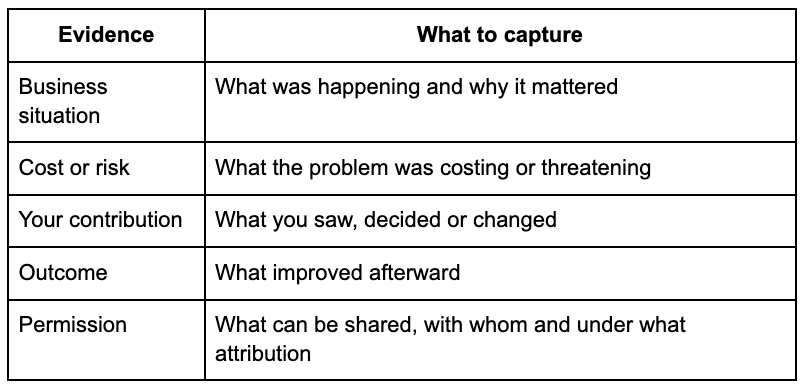
You may not be able to publish every company name or number.
That does not make the evidence useless.
You can anonymize a story while preserving the size of the problem, the nature of your intervention and the result.
Your proof target
Make ten requests this month.
Turn the responses into at least three short proof stories that show what you recognized, what you changed and why it mattered.
Do not release them yet.
Bank them.
4. Reduce the commercial risk before resigning
The riskiest sequence is:
Resign
Announce
Decide what you sell
Start looking for a client
The stronger sequence is:
Define the buyer and problem
Validate both through conversations
Package one clear offer
Build proof
Create qualified opportunities
Secure the first engagement where permitted
Resign
Activate everything you prepared
A promising conversation is not a client.
Neither is someone telling you they would love to work together someday.
Where your employment agreement permits you to enter a future engagement, landed means:
A signed scope
A committed start date
Clear payment terms
A start date after your notice period
No delivery performed using your employer’s time or resources
Senior people have notice periods. Reasonable buyers understand that and can plan around a future start date.
If your employment agreement prevents you from signing an outside engagement, remove as much uncertainty as you lawfully can.
That could include validated demand, a defined offer, written buyer intent, multiple qualified opportunities and enough personal runway to manage the gap.
The goal is not to pretend there is no risk.
It is to avoid creating unnecessary risk by resigning before you have tested whether anyone will buy what you intend to sell.
Prepare the launch before the launch
While you are still employed, draft the assets you will eventually need:
Your new LinkedIn headline
Your rewritten About section
Your services page
Your primary offer
Your case studies
Your recommendations
Your announcement
Your outreach messages
Your target-company list
Your pipeline tracker
Keep anything that signals availability private until the timing is appropriate.
When the transition becomes official, you are not beginning from zero.
You are activating work that has already been tested and prepared.
Your public identity can change in an afternoon.
The business behind it should have been under construction for months.
The Quiet-Launch Scorecard
Before you resign, aim to have:
Clear written boundaries around what you can and cannot do
One specific market you can target
One costly problem you are known for solving
Forty non-conflicted target companies
At least ten completed buyer conversations
One defined initial offer
Three proof stories
Written recommendations ready to publish
A private pipeline with real opportunities
A first engagement or the strongest commitment your employment terms permit
Drafted launch assets ready to activate
You do not need a large audience.
You do not need to post every day.
You do not need to tell everyone what you are planning.
You need evidence that the market recognizes the problem, buyers value the outcome, and your experience can be turned into something they understand and buy.
Your first five days
If you are still employed and want to begin, this is your work for the next week:
Day 1: Review your employment agreement and document the boundaries.
Day 2: Choose one market, one buyer and one costly problem to investigate.
Day 3: Build the first ten companies on your forty-company list.
Day 4: Send three invitations for private buyer conversations.
Day 5: Ask two people from earlier in your career for a written recommendation.
None of those actions requires a public announcement.
All five move the business forward.
There is no universal countdown
Dr. Orletta Caldwell built her fractional interim director business alongside a full-time nonprofit executive director role for eight years before deciding to make it her full-time work.
The lesson is not that you should wait eight years.
It is that there is no universal clock counting down from the moment you begin exploring fractional work.
Some people transition in months. Others build more gradually.
What matters is that the decision is based on evidence rather than frustration.
Your employment is not necessarily preventing you from building.
It may be funding the research, authority and preparation that make a successful transition possible.
Use the runway while you have it.
Broadcast the expertise, never the availability.
Have conversations instead of making announcements.
Bank the proof before you need it.
Reduce the commercial uncertainty before you resign.
Then, when you do step into the market, you will not look like someone who started a fractional business that morning.
You will look like what you are:
An experienced executive with a clear market, a valuable offer, credible proof and a business ready to move.
If you are exploring fractional work and need a clear path from corporate expertise to positioning, packaging, promotion and pipeline, join me for The Fractional Executive Revolution. It is a free 45-minute live session on what it takes to build a fractional business that runs like a business.
Fractional powerhouses are not born. They are built.
— Sue

Connect on LinkedIn | The Fractional Formula (Book) | FractionalOS™ | Hire A Fractional™
The distinction between broadcasting expertise and broadcasting availability is one of the most practically useful pieces of advice I have come across for professionals building toward fractional work, and the quiet launch scorecard gives it genuine structure. The observation that your employment may be the best runway your fractional business will ever have is one that most people only understand in retrospect. Have you found that the professionals who follow this sequence most faithfully tend to transition more quickly, or does the patience required to do it properly actually slow some people down?