


“Every engagement is customized.”
It is one of the most expensive sentences in the fractional business.
It sounds generous.
It sounds flexible.
It sounds client-first.
It also tells the buyer almost nothing about what will happen after they hire you.
Worse, it hands them a new set of questions:
How will you decide what we need?
Where will you start?
How long will this take?
What will it cost?
What happens if the scope keeps changing?
Have you solved this before, or will you be building the process on us?
You meant:
I will not force your company into a cookie-cutter solution.
The buyer may hear:
There is no defined approach, so you will have to trust me and hope it works.
You meant flexibility.
They heard risk.
Customization transfers uncertainty to the buyer
The buyer already knows their company is different.
Their people are different.
Their systems, politics, budget, history, and constraints are different.
They expect your recommendations to reflect that.
But they are not asking whether you can adapt.
They are trying to establish whether you know what happens next.
They want evidence that you have solved this type of problem before.
They want to know that you can recognize the real issue, choose the right priorities, and move the company through the work in the right order.
“Every engagement is customized” does not give them that confidence.
It transfers the uncertainty from you to them.
Now the buyer must believe that somewhere inside your résumé is a process you have not yet shown them.
The buyer’s translation
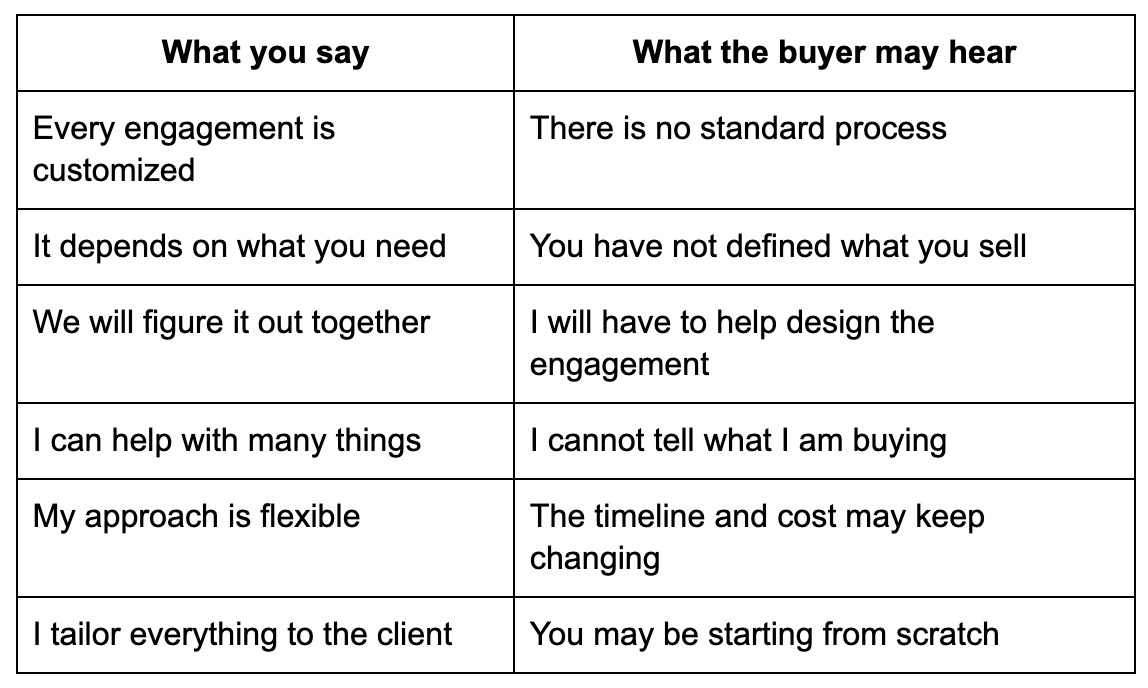
This does not mean the buyer doubts your intelligence.
They may be extremely impressed by your career.
But being impressed is not the same as being ready to buy.
Your résumé proves that you have experience.
Your proprietary method proves that you know how to apply it.
The buyer needs something they can repeat without you
Your buyer is rarely making the decision alone.
Even a CEO may need to explain the engagement to a CFO, board member, investor, business partner, or leadership team.
They need to be able to say:
“This is the problem we are solving.”
“This is how Sue approaches it.”
“These are the major stages.”
“This is what should change.”
“This is why we believe her process will work.”
If your offer can only be understood while you are in the room explaining it, the sale becomes weaker as soon as you leave.
The buyer needs language they can carry into the next conversation.
A proprietary method gives them that language.
Your proprietary method is the bridge
A proprietary method is the repeatable system you use to move a client from a specific problem to a desired business outcome.
It is not a list of services.
It is not a pile of deliverables.
It is not your job description.
It is not a clever acronym placed over generic consulting work.
It is the logic underneath how you solve the problem.
After twenty or thirty years in your field, you do not enter a company with a blank mind.
You know what to examine first.
You ask certain questions.
You recognize patterns.
You know when the obvious problem is not the real problem.
You know which decision must happen before the next one can be made.
You know where companies usually stall.
You know what early progress looks like.
That is your method.
You have been using it for years.
You simply have not made it visible yet.
The work can be customized. The method cannot be invented every time.
A proprietary method does not mean giving every client identical advice.
It does not mean using the same tools regardless of the situation.
It does not mean forcing every company through a rigid process that ignores what is actually happening.
It gives the engagement a stable spine.
The application flexes around it.
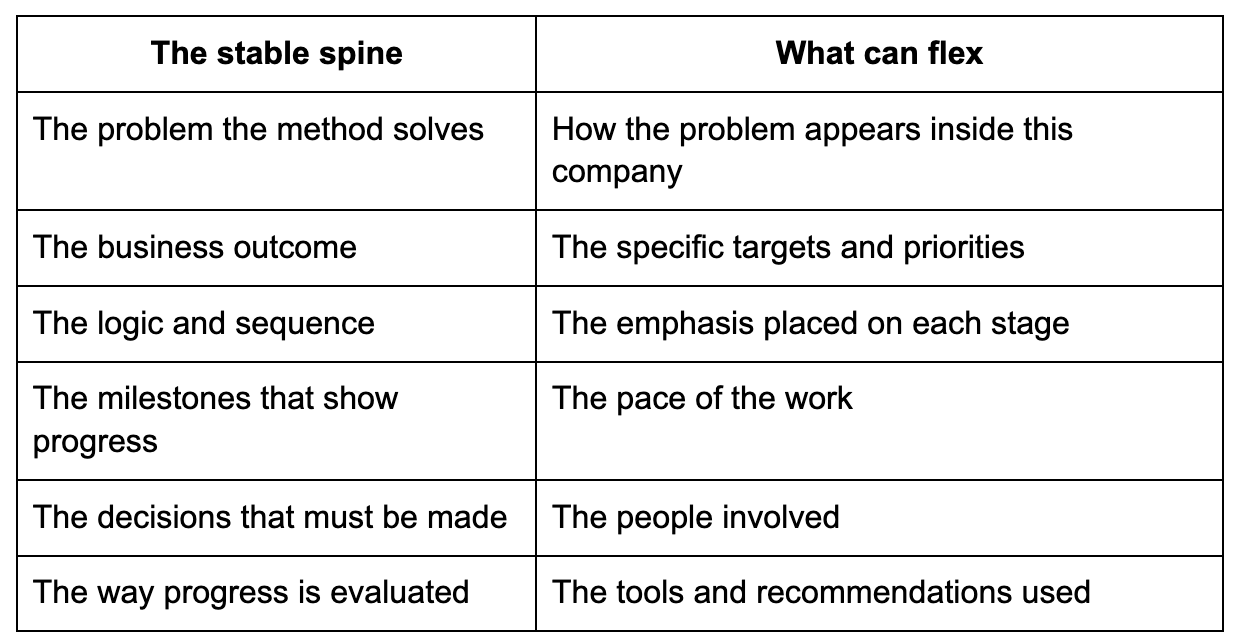
A Fractional COO may always begin by identifying where execution is breaking.
At one company, the root cause may be unclear decision rights.
At another, it may be poor handoffs, excess inventory, missing operating rhythms, or weak accountability.
The diagnosis changes.
The disciplined way the COO reaches that diagnosis does not.
That is the difference between customized delivery and improvised delivery.
What changes when the buyer can see your method
A visible method does four important things.
It lowers risk
The buyer can see that you are not starting from zero.
There is a path, a sequence, and a way to judge progress.
It makes the offer easier to understand
The buyer no longer has to translate a long list of capabilities into something they can purchase.
They can see how the work moves them from the current problem to the desired outcome.
It makes your expertise easier to trust
Buyers cannot see thirty years of judgment operating inside your head.
Your method makes part of that judgment visible.
It changes the price comparison
Without a proprietary method, buyers compare you with everyone else who shares your title.
Fractional COO against Fractional COO.
Fractional CFO against Fractional CFO.
Fractional CMO against Fractional CMO.
The conversation moves quickly to fees, hours, and availability.
A proprietary method changes what they are comparing.
You are no longer another executive selling time.
You are the person with a defined way to solve this particular problem.
The Five-Part Method Spine
Before you name your method or turn it into a diagram, you need five things.
1. The trigger
What is happening when the buyer realizes they need help?
Not the broad category of work you perform.
The specific moment when the problem becomes urgent.
Growth has outpaced the company’s operating systems.
An acquisition has closed, but the teams are not integrating.
Revenue is growing while margins are shrinking.
The board no longer trusts the numbers.
The company keeps missing commitments to customers.
The trigger tells the buyer when your method becomes relevant.
2. The transformation
What is different after your method has been applied?
Do not answer with activities:
A strategy
A dashboard
Weekly meetings
An assessment
A new process
Those may be part of the work, but they are not the transformation.
The transformation is the meaningful change:
Delivery becomes predictable.
Leadership can trust the financial picture.
Decisions happen at the right level.
The company can absorb growth without breaking.
The acquisition begins creating value.
The CEO is no longer the operating system.
The buyer needs to understand where you are taking them.
3. The sequence
What has to happen, and in what order, to create that transformation?
This is where experience becomes commercially valuable.
An inexperienced person sees a list of problems.
An experienced executive sees dependencies.
You know that new software will not fix broken decision ownership.
You know that more leads will not rescue a weak offer.
You know that a dashboard is useless when nobody trusts the data.
You know that scaling a broken process only creates a larger problem.
Your method captures the order in which the right things must happen.
4. The proof points
How will the buyer know the method is working before the final result is achieved?
A senior buyer does not want to wait six months before seeing evidence of movement.
Your method should produce visible signs of progress:
Faster decisions
Clear ownership
Fewer missed handoffs
Better forecast accuracy
Reduced backlog
Improved margin visibility
Leadership alignment around priorities
These proof points reduce uncertainty during the engagement.
5. The flex points
Which parts of the work will change based on what you find?
The diagnosis may change.
The priorities may change.
The pace, stakeholders, tools, and recommendations may change.
That is where customization belongs.
Customization should happen inside your method, not instead of having one.
The Three-Win Method Extraction Exercise
Set aside thirty minutes.
Choose three situations from your career where you solved the type of high-value problem you now want clients to hire you to solve.
Do not choose your three most prestigious projects.
Choose three where your judgment materially changed the outcome.
For each situation, answer these questions:
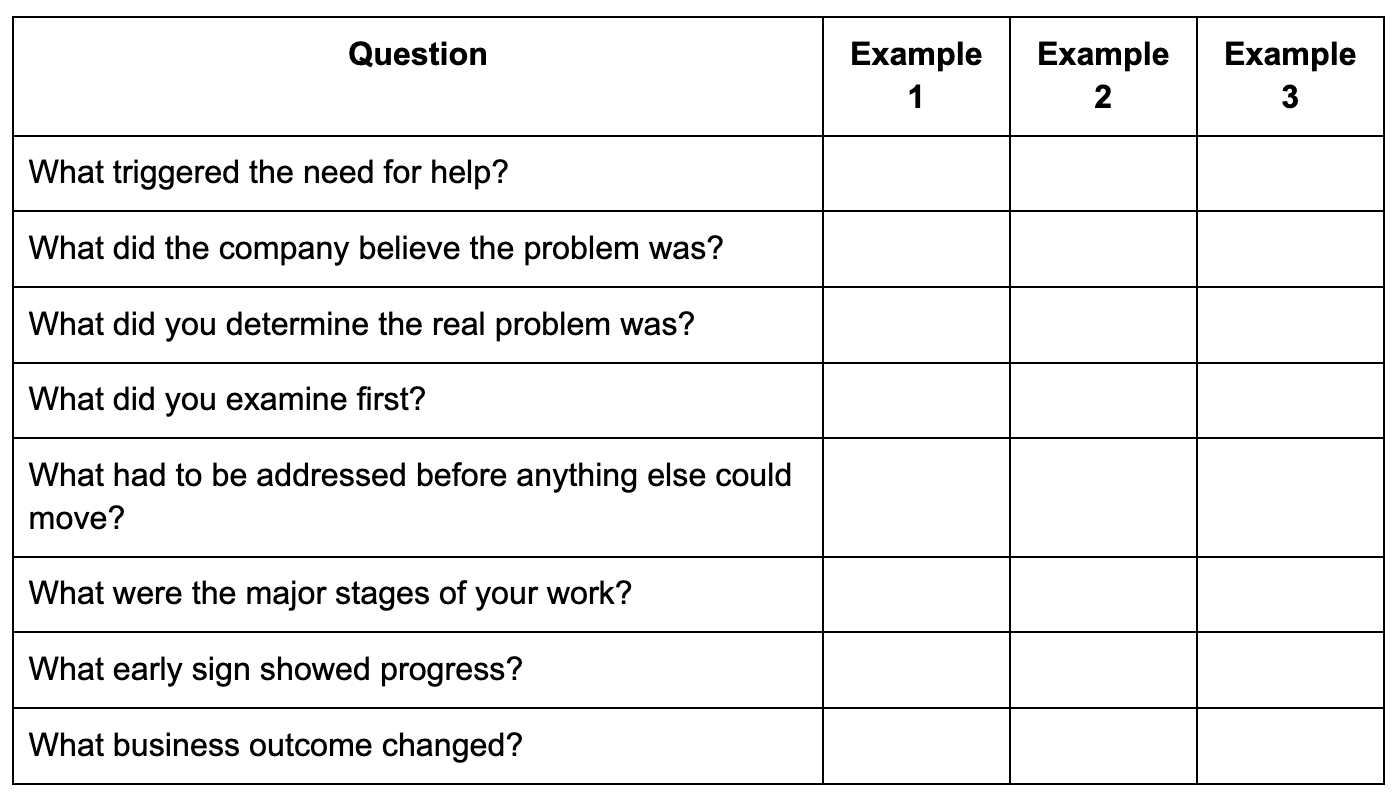
Now compare the three columns.
Circle anything that appears more than once.
Look for:
Questions you asked in every situation
Information you consistently examined first
Problems that were repeatedly misdiagnosed
Decisions that had to happen in a specific order
Interventions you used more than once
Milestones that signalled progress
Outcomes the organization valued most
The repeated elements are not coincidence.
They are evidence of your method.
Write the rough version in plain English
Do not name it yet.
Do not force it into an acronym.
Do not design the diagram.
Complete this statement:
When [business trigger] happens, I help [buyer or company] move from [current condition] to [business outcome]. I begin by [first major stage], then [second major stage], followed by [third major stage]. The recommendations vary by company, but this sequence allows us to [reason the method works].
For example:
When rapid growth begins creating delivery failures, I help founder-led software companies move from reactive execution to a predictable operating rhythm. I begin by identifying where decisions and handoffs are breaking, then clarify ownership and priorities, followed by installing the operating cadence required to sustain execution. The exact systems and recommendations vary, but this sequence prevents the company from automating or scaling the wrong processes.
That is not a finished proprietary method.
But it is far stronger than:
Every engagement is customized based on the client’s needs.
One tells the buyer you will adapt.
The other tells the buyer you know how to lead.
Do not brand confusion
A clever name does not make a method proprietary.
Neither does a polished diagram.
If the logic is weak, an acronym only makes the confusion look more professional.
The method must exist before the branding matters.
It must reflect how you actually solve the problem.
It must connect the buyer’s current condition to the outcome they want.
It must show a sequence built from experience, not words built for marketing.
The method comes first.
The branding makes it memorable.
The proof makes it valuable.
What to say instead
The next time a buyer asks how you work, do not lead with customization.
Say:
I use a repeatable method to move clients from [current problem] to [desired outcome]. It gives us a clear path and measurable milestones, while the priorities and recommendations are tailored to what we find inside your business.
That tells the buyer two things at once:
You have a proven way to solve the problem.
You will apply it intelligently to their company.
That is what buyers actually want.
They do not want a generic solution.
They also do not want to pay you to invent your approach after the contract is signed.
They want the benefit of the questions you already know to ask, the patterns you already recognize, the mistakes you know to avoid, and the sequence you know creates progress.
Customization without a method creates uncertainty.
A method without customization creates rigidity.
The strongest fractional offer has both:
A repeatable system underneath it.
Experienced judgment inside it.
And enough flexibility to apply both to the business in front of you.
If you are ready to turn your corporate experience into a fractional business with clear positioning, a valuable offer, and a pipeline that does not depend on luck, join me for The Fractional Executive Revolution.
It is a free 45-minute live session on what it takes to build a fractional business that runs like a business, not a perpetual job search.
Fractional powerhouses are not born. They are built.
— Sue

Connect on LinkedIn | The Fractional Formula (Book) | FractionalOS™ |