

Part 1 covered the macro number: interim C-suite demand up 151% since 2021. That number proves the market is real. It does not tell you where you fit inside it. The rest of this report does, and the first thing it shows breaks an assumption a lot of positioning advice leans on.
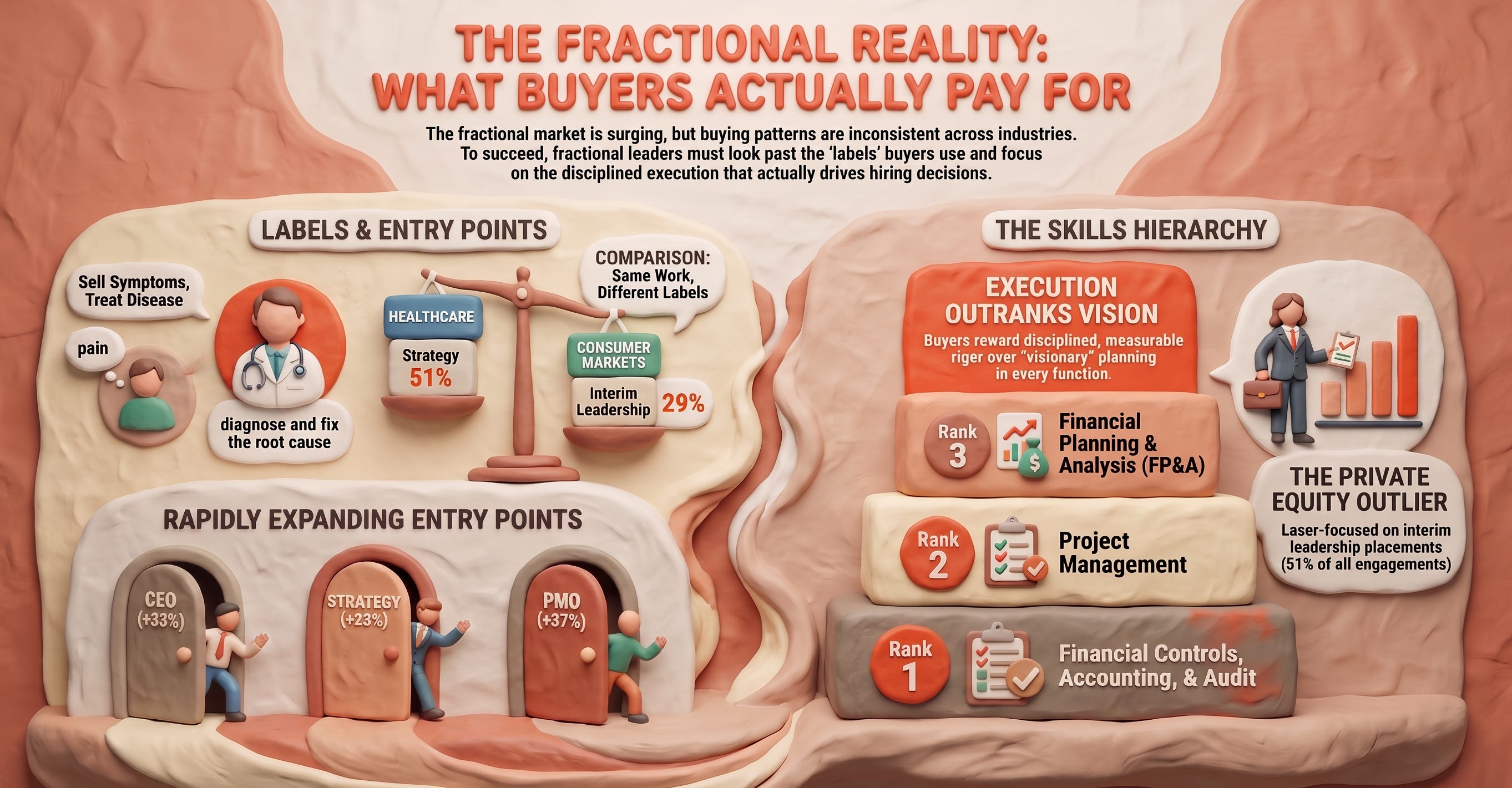
The same type of work sells at a completely different rate depending on which industry is buying it.
Quick note before the rankings: everything below is interim data again, same as last week. I am reading it as a direct map of buyer behaviour that applies to how you position fractional work, for the reasons I laid out in Part 1. I am not re-arguing that bridge here. Just carrying it forward.
Healthcare and life sciences, consumer markets, and technology and services are the three largest industries in this report by volume of engagement requests. That much is predictable. What is not predictable is what buyers in each one are actually purchasing.
Industry decides the label, not the job
In healthcare and life sciences, 51% of all engagements are strategy work. In consumer markets, strategy drops to 28% of engagements, and interim leadership placements climb to 29%, nearly matching it. In technology and services, strategy sits at 40%, with interim leadership at 22%. Same three industries. Three different buying patterns, for the same kind of talent.
Do not read that as two different products. A fractional executive does three things inside the same engagement: sets the strategy, leads the implementation of it from inside the organization, and owns the result. That combination is the value proposition, and it does not change by industry. What changes is which part of the work the buyer puts on the purchase order. Healthcare files more of the engagement under strategy. Consumer markets files more of it under interim leadership. Either way, the buyer is getting all three. They are just labelling the invoice differently.
Three doors, opening at different speeds
Growth in who is requesting talent is not evenly distributed either. Year over year, requests directly from CEOs and presidents are up 38%. Requests from strategy and internal consulting groups (ICGs) are up 23%. Requests from program management offices (PMOs) and transformation teams are up 37%.
These are three separate entry points into the same organization, not one funnel with three names. A CEO’s office, an internal consulting group, and a PMO each initiate engagements on their own timeline and their own logic. Treating them as interchangeable flattens three distinct openings into one, at exactly the moment all three are accelerating.
You are not a Chinese restaurant menu
Every one of those three doors hands you an order already written. A CEO wants someone to fill a gap. A strategy group wants a model. A PMO wants a schedule kept on track. That is not a strategy conversation. That is a Chinese restaurant, and the client is reading off the menu: two chicken balls, a side of fried rice.
Take the PMO door as the example. The stated order is: keep the technology rollout on schedule. Half the time, what is actually broken is that no one has told the C-suite the schedule is already slipping, and there is no executive sponsor forcing the trade-off decisions the rollout needs to stay on track. You can fill the order exactly as placed and manage the schedule. Or you can do what a doctor does. Listen to the symptom, diagnose the actual problem, and treat that, while still delivering the schedule they asked for.
The client knows where the pain is. They do not know what will fix it. That is exactly why they called someone senior instead of posting a job description. Sell them what they want. Give them what they need.
Execution outranks vision
Rank every skill requested across every industry and function in this report, and the top five are: financial controls, accounting, and audit; project management; financial planning, analysis, and modeling; strategic planning; technology and systems implementation.
Two of those five are finance skills. The other three, project management, strategic planning, and technology and systems implementation, apply to any function. Buyers are not asking for a finance person. They are rewarding disciplined execution over vision, in every seat. A fractional CMO who runs a tight, measurable launch competes on the same terms as a fractional CFO who runs a tight, measurable close. Strategic planning is fourth. Vision sells on top of rigor, not instead of it.
The industry that breaks its own pattern
One industry does not follow any of this. In private equity, 51% of all engagements are interim leadership placements, the highest concentration of any industry in the report. Every other industry splits its demand across strategy, operations, and transformation work. Private equity does not. If you already operate in that world, this is the narrowest, most concentrated lane in the entire data set.
What this data is, and is not
Same caveat as last week, because it still applies. These rankings come from Heidrick & Struggles’ own search-firm engagements across North America and Europe, weighted toward enterprise and large mid-market companies. There is no pricing data attached to any of it. A high-ranking skill or industry here tells you where enterprise demand concentrates. It does not tell you what that demand pays.
Next week
Part 3: how to pitch the moment instead of the title, using this report’s data on what actually triggers a hire.
Fractional powerhouses are not born. They are built.
— Sue

Connect on LinkedIn | The Fractional Formula (Book) | FractionalOS™ | Hire A Fractional™
Thanks for reading The Fractional Pipeline! Subscribe for free to receive new posts and support my work.