

Every year, Heidrick & Struggles, one of the largest executive search firms in the world, publishes a report on the interim talent economy: who is hiring interim executives, at what level, and why. I read the 2026 edition this week, and one number stopped me.
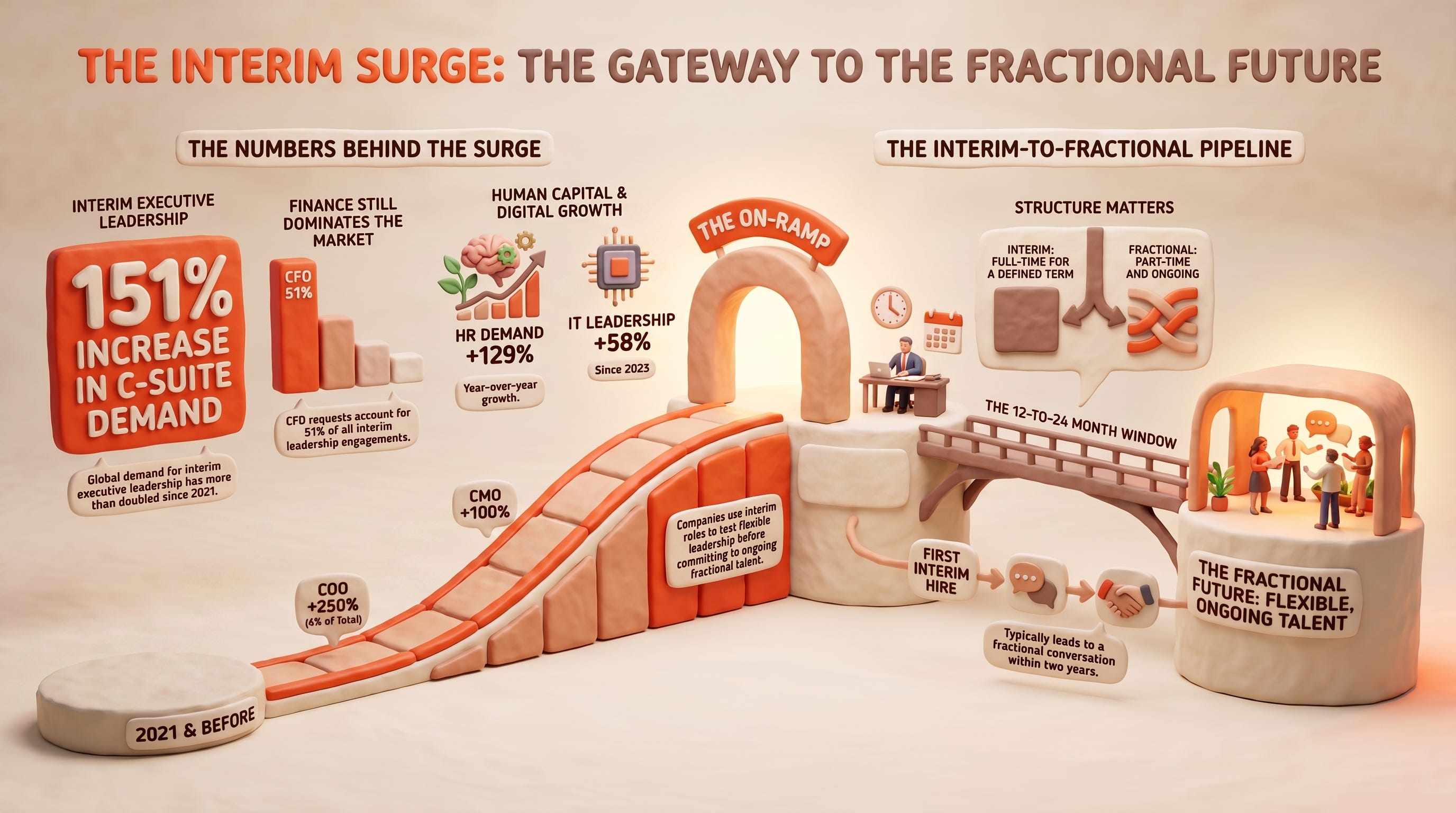
Demand for interim C-suite leaders is up 151% since 2021.
Read that again, then look at the breakdown. Year over year: COO requests up 250%. CMO requests up 100%. CEO requests up 24%. CFO requests up 14%. Human capital demand, the core of HR’s work, is up 129% year over year. Digital, data, and IT leadership demand is up 58% since 2023. Finance is still the single largest function, accounting for 51% of all interim leadership requests. That is more than every other function combined, and it is not close.
This is not a fringe data point buried in a niche report. This is one of the largest executive search firms on the planet telling its enterprise clients, in writing, that outside leadership is standard operating procedure now. Not a workaround. Not a stopgap. The default.
Interim is not fractional
This is interim data. Not fractional data. Most people in this space use the two words interchangeably, and it costs credibility with buyers who already know the difference.
Interim means one client, full-time, for a defined term, usually six to eighteen months, while a company fills a permanent seat. Fractional means multiple clients, part-time, ongoing. Different structure. Different economics. Different buyer conversation entirely.
Here is why the distinction matters beyond precision: interim is the on-ramp. Companies with no history of engaging outside executives test the model through interim first, because it looks familiar on paper and comes with a defined end date. Once a company has run one good interim engagement, the internal resistance to flexible senior leadership tends to disappear. That is the door fractional walks through next, for the ongoing capability a company needs without filling a full-time seat.
A 151% surge in the on-ramp tells me something specific: this market is not warming up to flexible senior talent. It has decided. That volume shows up in fractional pipelines within twelve to twenty-four months, whether anyone selling fractional services notices it happening or not.
Heidrick & Struggles just said the quiet part out loud
A firm that has spent decades placing permanent, full-time executives now describes interim leadership as “an established operating model, rather than a stopgap solution.”
I have been saying a version of this for years. It is satisfying to watch one of the most established search firms in the industry catch up to the argument. But do not mistake this for opinion. This is the industry’s own gatekeeper, in its own words, telling its own enterprise clients that outside leadership is not a placeholder. The debate about whether flexible senior leadership is a legitimate category is over. The data closed it.
Three things worth knowing before your next pitch
Track first-time interim hires. A company running its first interim CFO or COO search right now is likely twelve to twenty-four months from a fractional conversation, whether it knows that yet or not. Most of you already have two or three of these companies in your network without realizing what you are looking at.
Do not read the growth percentages at face value. COO requests are up 250% year over year, but COO is still 4% of the interim C-suite mix. CFO is up a comparatively modest 14%, but is 51% of that mix. The market is not moving away from finance. It is adding new categories fast, from a small base. That distinction changes what these numbers mean, depending on where you sit.
HR and digital look smaller in the C-suite data than they actually are. Human resources is the single most requested business function in the entire report, yet placements for the top HR seat, whether titled CHRO (Chief HR Officer) or CPO (Chief People Officer), are 7% of interim C-suite requests. Digital, data, and IT touch 25% of all requests across every function, yet CIO, CTO, and CISO placements are 12% of the C-suite mix. That gap is not a ceiling on either market. It means most of the demand shows up as expertise embedded inside someone else’s engagement, not as a request for that specific title. The real opportunity in both lanes is bigger than the C-suite numbers alone suggest.
What this data is, and is not
Heidrick & Struggles sourced this from its own search-firm engagements across North America and Europe, weighted toward enterprise and large mid-market companies. There is no pricing or day-rate data in it, and it measures interim demand, not fractional demand directly. I am treating it as a signal of where flexible senior talent is headed, not a mirror of your specific pipeline. Keep that in mind before you quote the 151% number to a prospect as if it is about you. It is not, yet.
Next week
Part 2: I am ranking exactly which industries, functions, and skills buyers are paying for right now, so you can see precisely where your background sits on the map.
Fractional powerhouses are not born. They are built.
— Sue

Connect on LinkedIn | The Fractional Formula (Book) | FractionalOS™ | Hire A Fractional™