

Twenty-five years of experience can earn you admiration without earning you a client.
This is one of the most confusing parts of becoming fractional.
You have a strong conversation. The buyer is impressed by your background. They recognize the companies you worked for. They ask thoughtful questions about your career.
You leave thinking it went well.
Then nothing happens.
“They loved my experience” is not the same as “They need to hire me.”
Your experience answered one question:
Are you capable?
It did not necessarily answer the questions that create a buying decision:
Do you understand what is happening in my business?
Can you see something we cannot?
Will involving you get us to the right outcome faster?
Experience is evidence. It is not the product.
Buyers do not pay you for having spent twenty-five years inside companies.

They pay for what those twenty-five years allow you to do.
They pay you to recognize the real problem before they waste six months solving the wrong one.
They pay you to know which decision matters, which risk is real, and which activity is merely creating noise.
They pay you to shorten the distance between uncertainty and action.
That is the commercial value of experience.
The years are evidence that you may be able to do those things. They are not, by themselves, a reason to buy.
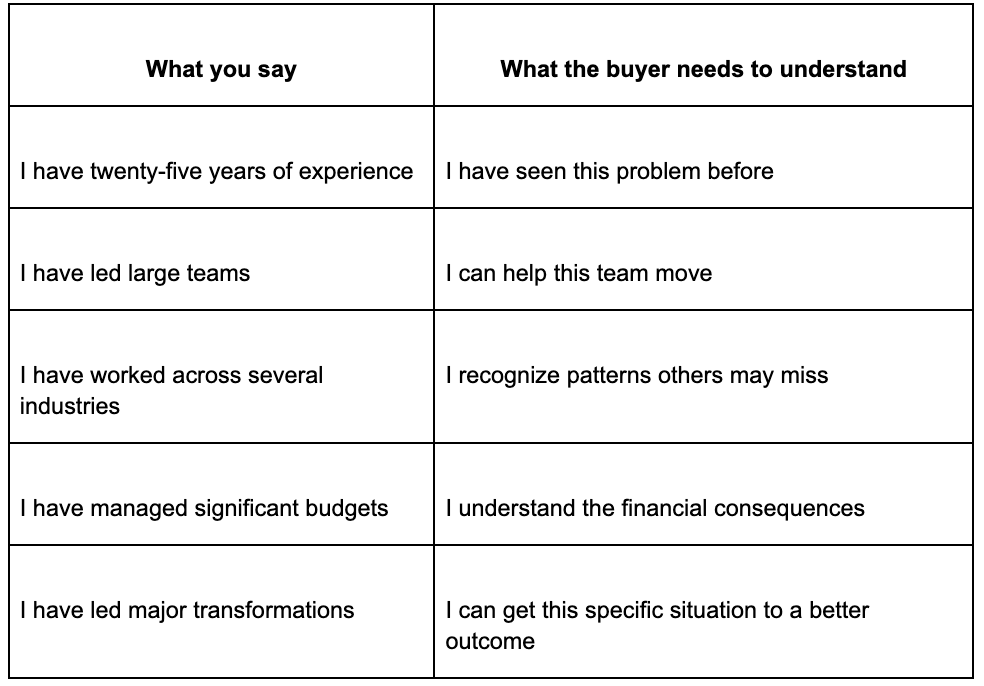
Your résumé describes where you have been.
Your fractional business must explain why that history matters to the buyer standing in front of you.
Why broad careers become difficult to sell
The longer and more successful your career, the more things you can probably do.
That feels like an advantage until someone asks what you sell.
Then everything comes out.
Strategy. Operations. Transformation. Leadership. Growth. Change management. Team development. Process improvement. Execution.
All true.
Almost impossible to buy.
Buyers do not purchase a collection of capabilities. They purchase help with a problem that has become too important, expensive or risky to leave unresolved.
This is why the most commercially valuable part of your career may not be your highest title or most prestigious employer.
It may be the problem people repeatedly pulled you in to solve.
The situation where somebody said:
“Can you take a look at this?”
“We cannot work out why this keeps happening.”
“We need someone who has seen this before.”
“That project is off track. Can you get it moving?”
Those moments contain more commercial information than your job description.
Your job description tells you what the organization expected you to own.
The messes tell you what people trusted you to fix.
The thread inside a scattered career
A career can look scattered when you read it vertically.
Different roles. Different functions. Different industries. Different companies.
Read it horizontally and a pattern may appear.
Perhaps you were repeatedly brought in when growth had outpaced the company’s systems.
Perhaps the leadership team could not turn strategy into execution.
Perhaps revenue looked healthy while margins quietly deteriorated.
Perhaps a product was technically strong but commercially stuck.
Perhaps acquisitions were completed without the operating integration required to create value.
The roles changed.
The problem shape did not.
That repeat is the beginning of your fractional value.
It does not mean the market no longer matters.
You still need a definable group of companies and buyers you can identify, find and reach.
Your niche determines whom you target.
Your problem pattern determines why they respond.
You need both.
A problem without a reachable market is not a viable position.
A market without a costly problem is only a list.
The Career Evidence Audit
Set aside forty-five minutes.
Do not open your résumé.
Do not begin with your titles, responsibilities or employers.
Start with the problems.
Step 1: Identify ten moments when you were pulled in
List ten situations from across your career where somebody specifically sought your help.
These do not need to be the largest projects you led.
Look for moments when:
Something important was stuck
The obvious solution had failed
Several teams could not agree
A decision carried significant risk
A leader needed somebody they trusted
You noticed something others had missed
The organization needed progress quickly
For each moment, complete this table:
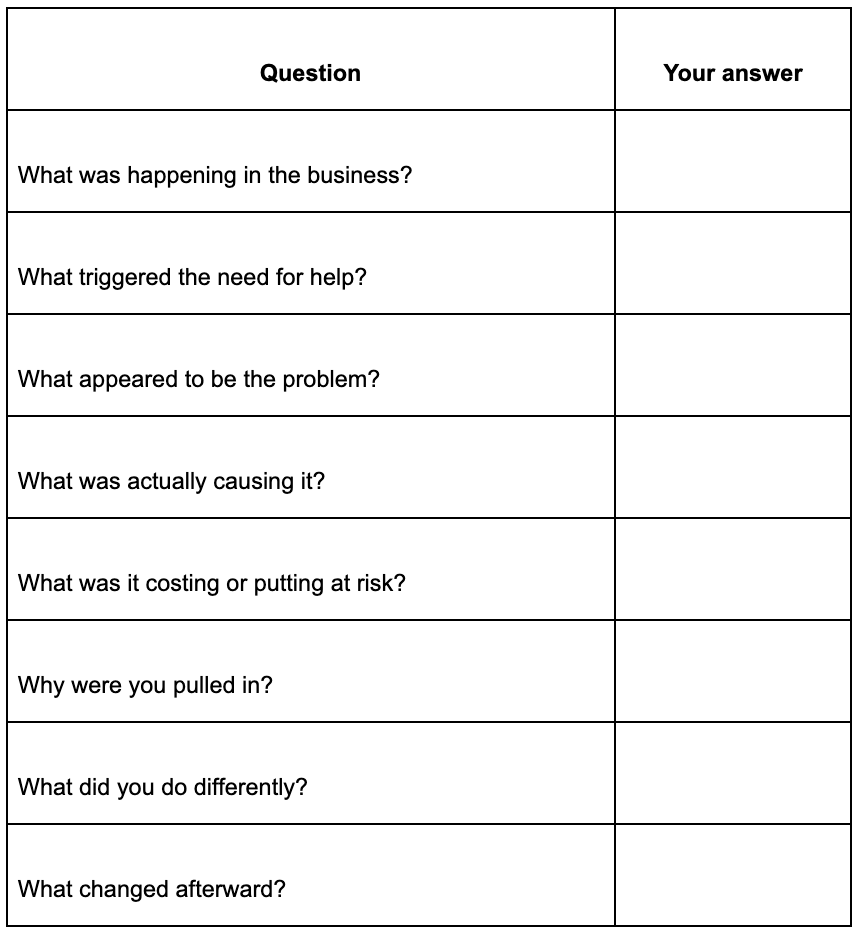
Use numbers wherever you genuinely have them.
Revenue protected. Costs reduced. Time recovered. Risk avoided. Deadlines met. Retention improved. Capacity created. Decisions accelerated.
Do not manufacture precision where none exists.
Observable business change is still evidence, even when it was not formally measured.
Step 2: Find the repeating problem shape
Now compare the ten situations.
Ignore the industry labels temporarily and look for repetition.
Ask:
Did the same trigger appear more than once?
Did leaders initially misdiagnose the problem in a similar way?
Were the same functions or teams involved?
Did the same type of buyer own the consequences?
Did you make a similar intervention?
Did the organization value the same kind of outcome?
What did you consistently notice before other people did?
You are not looking for ten identical projects.
You are looking for three or more situations with the same underlying shape.
That repeat is evidence that you have more than general experience.
You have pattern recognition.
Step 3: Score your strongest problem patterns
You may find several possible threads.
Do not choose the one that sounds most impressive. Score each one against the conditions required to build a business.
Use a score from one to five.
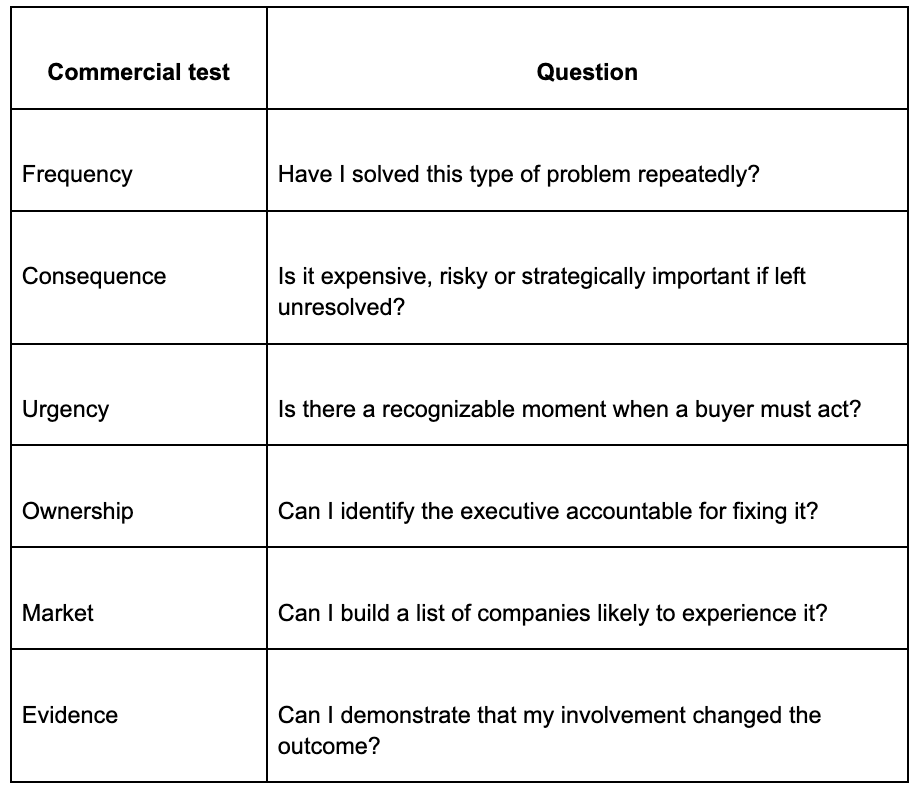
The strongest opportunity usually sits where all six overlap.
You know the problem.
The buyer cares about it.
The consequences are meaningful.
The market is large enough to target.
You have evidence that you can create a result.
If you cannot identify the accountable buyer, you do not yet have a marketable problem.
If you cannot build a list of companies likely to experience it, you do not yet have an operational niche.
If the problem is frustrating but carries little business consequence, it may not support premium fractional work.
Step 4: Translate experience into buyer value
Now turn the strongest pattern into a commercial statement.
Use this structure:
When [trigger] happens, [type of company] often discovers that [underlying problem] is preventing it from [business outcome]. I help [accountable buyer] correct it before [financial, operational or strategic consequence].
For example:
When rapid growth starts exposing delivery problems, founder-led software companies often discover that the issue is not team capacity but the absence of a scalable operating rhythm. I help the CEO and leadership team rebuild that rhythm before missed commitments begin affecting customers, retention and growth.
This statement does not attempt to summarize an entire career.
It gives the right buyer a reason to care about it.
Your experience belongs underneath the statement as proof:
I have handled this problem across multiple growth stages, including [relevant result], [relevant result] and [relevant result].
Problem first.
Outcome second.
Evidence third.
Your biography comes after the buyer understands why it matters.
Step 5: Build three proof stories
For each of your three strongest examples, write five sentences:
What was happening?
What was it costing or putting at risk?
What did others believe the problem was?
What did you identify or do differently?
What changed as a result?
This is not a case study yet.
It is the raw material for one.
A proof story should demonstrate judgment, not merely activity.
Weak proof sounds like:
I led a cross-functional transformation involving twelve stakeholders.
Stronger proof sounds like:
A critical transformation had stalled because twelve stakeholders were operating against different definitions of success. I established one decision framework, clarified ownership and rebuilt the operating cadence, allowing the team to move forward without adding headcount.
The first describes your responsibility.
The second shows what you saw, what you changed and why it mattered.
Step 6: Take the pattern to the market
Do not ask people whether they like your idea.
They will be polite, and politeness is terrible market research.
Speak with five people who understand the companies or buyers you intend to target.
Ask:
When this problem occurs, how is it described internally?
What usually triggers it?
What happens if it remains unresolved?
Who becomes accountable for fixing it?
What has the company usually tried before seeking outside help?
What makes the problem urgent enough to fund?
What would a successful outcome be worth?
Listen for the buyer’s language.
You may describe the problem as “operational misalignment.”
The buyer may call it “missing every commitment we make to the board.”
Their language belongs in your positioning.
Yours belongs in the method.
What buyers are actually paying for
Buyers are not purchasing your past.
They are purchasing a different future with less uncertainty attached to it.
Your experience becomes valuable when it allows you to:
Diagnose the problem faster
See consequences earlier
Avoid expensive false starts
Make better decisions with incomplete information
Create alignment around the right action
Reach the business outcome with less time and risk
This is also what allows you to command premium rates.
Your price is not justified by how long you have worked.
It is justified by the economic distance between what is happening now and what becomes possible after you intervene.
Thirty years of experience is impressive.
Preventing a costly mistake, restoring momentum or unlocking a meaningful business result is valuable.
Buyers understand the difference.
What to complete this week
By Friday, create:
One repeatable problem pattern from your career
One clearly defined buyer accountable for solving it
One trigger that makes the problem urgent
One business outcome your involvement helps create
Three proof stories demonstrating your judgment
A list of companies likely to experience the problem
Five buyer conversations to test the language and urgency
That is how you turn a broad career into a fractional business.
You do not discard the rest of your experience.
You organize it around the part buyers value most.
Your career was not scattered
It may only look scattered because you have been reading it as a sequence of jobs.
The buyer does not need the chronology.
They need the pattern.
They need to know that you have seen this situation before, that you understand what is really happening, and that involving you will help them reach the right outcome faster.
Your career is the evidence.
Your judgment is the product.
The business outcome is the value.
Across this series, we have looked at what you are building, the infrastructure that disappeared when you left corporate, the order behind a predictable pipeline, and the value hidden inside your experience.
None of it requires you to become someone new.
It requires you to turn what you already know into something visible, understandable and buyable.
That is the work we do inside FractionalOS: Positioning, Packaging, Promotion and Pipeline, built around the commercial value of your experience.
Fractional powerhouses are not born. They are built.
— Sue

Connect on LinkedIn | The Fractional Formula (Book) | FractionalOS™ | Hire A Fractional™
And you just pointed out some of the marketing issues I am having. Thank you!
The distinction between experience as evidence and judgment as the product is one of the most useful reframes I have come across for experienced professionals making the transition to fractional work. The Career Evidence Audit is genuinely practical, and the observation that the messes tell you more about your commercial value than your job description does is something I find myself returning to constantly with the Portfolio Executives I work with. Have you found that people tend to underestimate their strongest problem pattern, or do they more often try to claim too many?